My wife caught me at the kitchen table at eleven o'clock at night with four browser tabs open, checking whether a bacoside percentage on some other site's brain-supplement chart actually came from the paper it cited. It didn't — not exactly. The number was close enough to sound right and far enough off to be useless. That's what fourteen months of testing supplements and logging results in a spreadsheet does to a person: once you've caught one figure that doesn't reconcile, you stop trusting the rest of the page until you've checked it yourself. Old habit from thirty years of accounting. My wife says the spreadsheet has more tabs than our tax returns ever did, and she's not wrong.
So this is the ingredient sheet I wish existed when I started. Every mechanism and every percentage below is checked against the actual paper or agency page behind it, not copied off whichever site happened to rank first. Where a source didn't hold up, I said so instead of quietly leaving the number in. Where a source flat-out disagreed with what everyone repeats about an ingredient, I went with the source.
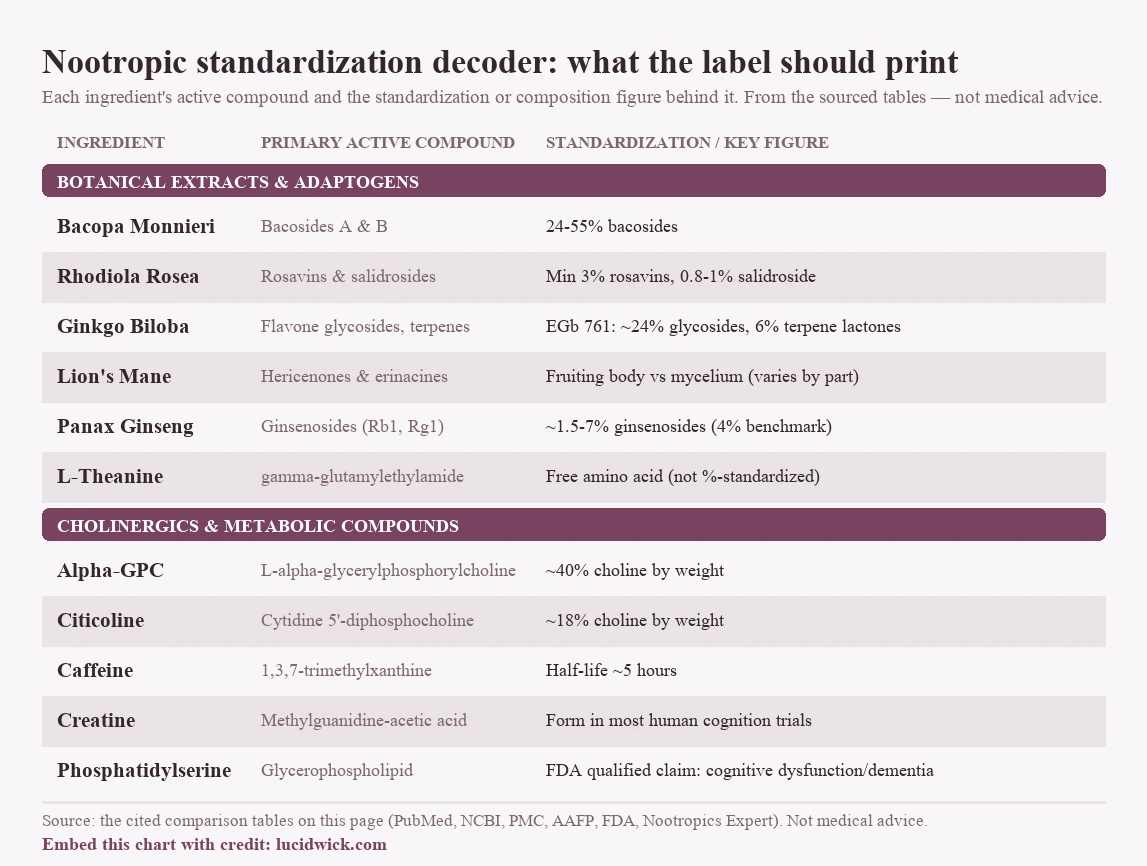
Standardization is the whole ballgame: alpha-GPC is about 40% choline by weight; citicoline only about 18% — so the same-size capsule delivers very different amounts of what you're actually after. And if a botanical's label doesn't print its rosavin, ginsenoside, or bacoside percentage, that number isn't a secret — it's just not on the label, and you can't dose what you can't see.
Botanical Extracts and Adaptogens
These are the plant-based ones, where the standardization percentage printed on the label is doing almost all the work — the same way the actual interest rate on a loan matters more than whatever the loan is named. I've cycled through most of these at costs anywhere from reasonable to what my wife flatly called a hobby that got out of hand. The rhodiola gummies were the low point: no rosavin or salidroside percentage listed anywhere on the bottle, six weeks logged, and not one line in the spreadsheet moved. They're in a drawer now. Below is what each of these actually is, and what the source behind each number actually says — not what the label wants you to assume.
| Ingredient | Primary Active Compounds | Mechanism of Action | Common Standardization |
|---|---|---|---|
| Bacopa Monnieri | Bacosides (A and B) | Antioxidant enzyme activity inhibits lipid peroxidation in the hippocampus and other brain regions; may also modulate acetylcholine release and receptor binding (NCBI). | 24% to 55% Bacosides (NCBI). |
| Rhodiola Rosea | Rosavins and Salidrosides | Stress-protective effects engage the hypothalamic-pituitary-adrenal (HPA) axis (PMC); root extracts also inhibit monoamine oxidase (MAO-A and MAO-B) in vitro (PubMed). | Standardized extracts contain a minimum of 3% rosavins and 0.8% to 1% salidroside (roughly a 3:1 ratio) (PMC). |
| Ginkgo Biloba | Flavone glycosides and Terpene lactones | Dose-dependent increase in cerebral blood flow; flavonoid fraction scavenges free radicals (PMC). | EGb 761 extract adjusted to ~24% flavone glycosides and 6% terpene lactones (PMC). |
| Lion's Mane | Hericenones and Erinacines | Hericenones and erinacines can induce Nerve Growth Factor (NGF) synthesis in nerve cell cultures (PubMed). | Hericenones occur in the fruiting body; erinacines occur in the mycelium — content varies by which part of the mushroom the extract is made from (Mycogenius). |
| Panax Ginseng | Ginsenosides (e.g., Rb1, Rg1) | Proposed adaptogen mechanism: research reviews suggest extracts affect the hypothalamus-pituitary-adrenal axis and the immune system (AAFP). | Standardized to a ginsenoside content of roughly 1.5% to 7%, with 4% cited elsewhere as a key benchmark (AAFP). |
| L-Theanine | γ-glutamylethylamide | Partial co-agonist at NMDA receptors (PubMed); animal studies suggest increased brain serotonin, dopamine, and GABA levels (PubMed). | Sold as a free amino acid rather than a percentage-standardized botanical extract. |
Cholinergics and Metabolic Compounds
This half of the sheet reads more like a chemistry set than a garden, but the audit logic doesn't change: what's the actual compound, and does the number attached to it survive a second look. A couple of these matter for a different reason than the botanicals above. Caffeine is the one ingredient on this whole page I never had to test to know the timing on — I've been running on it since long before any of this started — and it's also the one most likely to already be sitting in your system alongside whatever else is in your medicine cabinet, which is exactly why the disclaimer below isn't just boilerplate I copy-pasted in.
| Ingredient | Primary Active Compounds | Mechanism of Action | Composition Fact |
|---|---|---|---|
| Alpha-GPC | L-Alpha glycerylphosphorylcholine | Choline fraction is used to produce acetylcholine, the neurotransmitter involved in focus, learning, and memory (NeuroVesa). | Roughly 40% choline by weight (Nootropics Expert). |
| Citicoline | Cytidine 5'-diphosphocholine | Cytidine fraction converts to uridine, which is involved in cell-membrane synthesis (NeuroVesa). | Roughly 18% choline by weight (Nootropics Expert). |
| Caffeine | 1,3,7-trimethylxanthine | Antagonizes all four adenosine receptor subtypes (A1, A2a, A2b, and A3); A2a antagonism is particularly responsible for the wakefulness effect (NCBI). | Mean half-life is approximately 5 hours in healthy adults (NCBI). |
| Creatine | Methylguanidine-acetic acid | Regenerates Adenosine Triphosphate (ATP) via the phosphocreatine system — about 40 times faster than oxidative phosphorylation and 10 times faster than glycolysis (PMC). | Monohydrate is the form used in most human cognition trials to date (PMC). |
| Phosphatidylserine | Glycerophospholipid | Present in neuronal membranes, where it modulates neurotransmitter release and synaptic signaling (PMC). | FDA allows qualified health claims for phosphatidylserine and cognitive dysfunction/dementia (FDA). |
Last verified: 2026-07-11
Sources
- Bacopa monnieri - StatPearls - NCBI Bookshelf
- Rhodiola rosea L.: an herb with anti-stress, anti-aging, and immunostimulating properties - PMC
- Monoamine oxidase inhibition by Rhodiola rosea L. roots - PubMed
- Current Perspectives on the Beneficial Role of Ginkgo biloba in Neurological and Cerebrovascular Disorders - PMC
- Neurotrophic properties of the Lion's mane medicinal mushroom, Hericium erinaceus - PubMed
- Hericenones vs Erinacines: Lion's Mane Compounds Explained - Mycogenius
- Panax Ginseng - American Family Physician
- Characterization of L-Theanine Excitatory Actions on Hippocampal Neurons - PubMed
- The neuropharmacology of L-theanine - PubMed
- Alpha-GPC vs. Citicoline: Which Choline Source Is Best for Brain Health? - NeuroVesa
- Alpha GPC - Nootropics Expert
- CDP-Choline (Citicoline) - Nootropics Expert
- Caffeine - StatPearls - NCBI Bookshelf
- (Phospho)creatine: the reserve and merry-go-round of brain energetics - PMC
- Effects of creatine supplementation on cognitive function of healthy individuals - PMC
- Phosphatidylserine in the Brain: Metabolism and Function - PMC
- Qualified Health Claims: Letters of Enforcement Discretion - FDA